Paper business cards still exist, but they no longer match the speed of modern business. People move fast, teams change details often, and nobody wants to lose a contact because a card was misplaced, damaged, or forgotten in a pocket. That is exactly why NFC cards are replacing paper business cards.
An NFC card turns a short introduction into an instant digital experience. One tap can open a professional profile, save contact details, show social links, display a company page, and guide the other person to the next step without friction. It feels faster because it is faster. It feels smarter because it removes the small delays that usually break momentum in networking.
Paper Cards Still Look Familiar, But They Create Friction
The problem with paper cards is not that they are traditional. The problem is that they are static.
Once printed, the information is frozen. If your phone number changes, your title changes, your company address changes, or your social links change, the card becomes outdated. That creates waste, extra printing cost, and missed opportunities.
Paper cards also depend too much on the receiver. They have to keep the card, read it later, type the details manually, and decide what to do next. Every extra step reduces the chance of a real follow-up.
NFC cards remove that friction. Instead of handing over information and hoping it gets used, you guide the person directly into your digital identity.
What Makes NFC Cards Different?
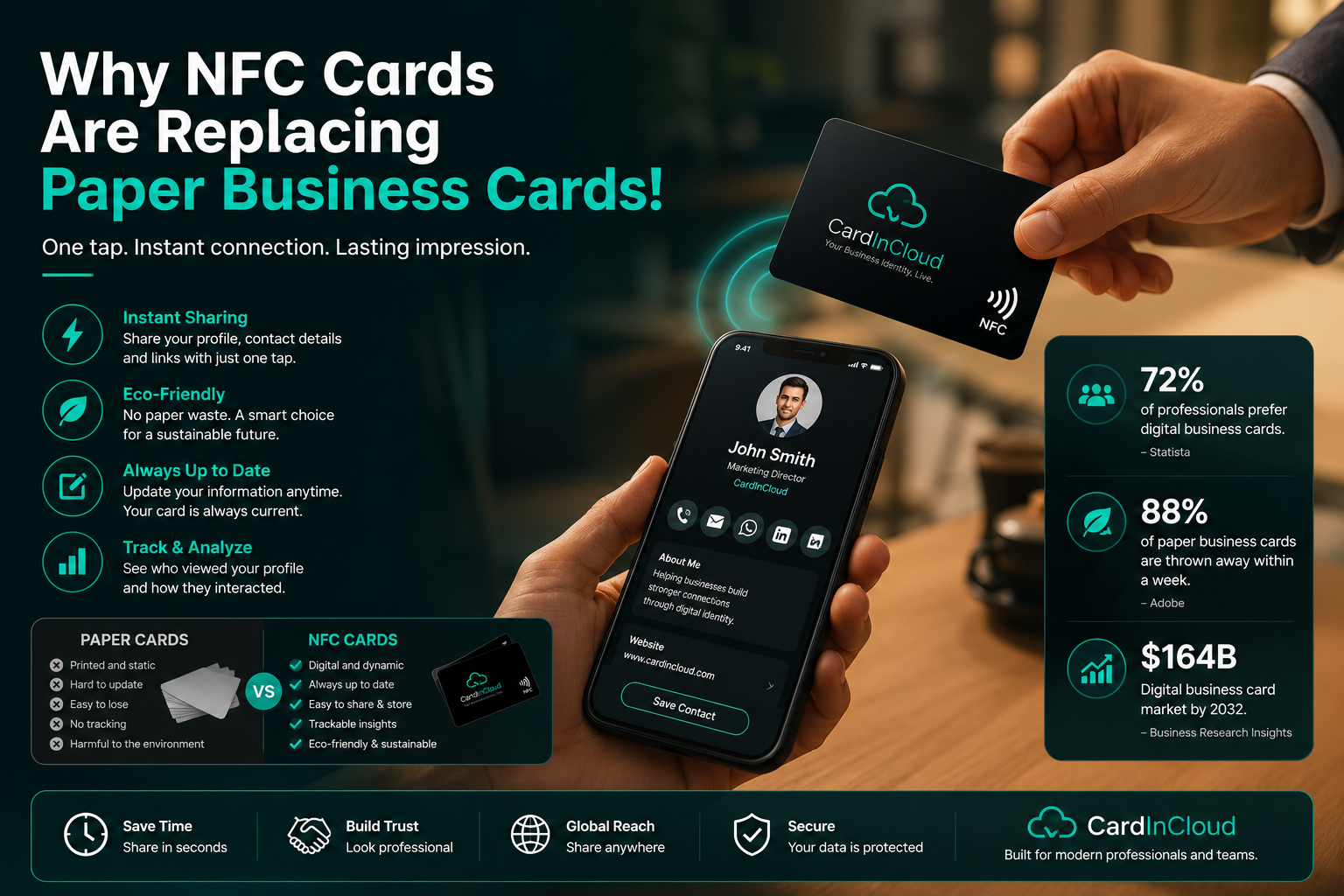
NFC stands for near-field communication. In simple terms, it allows one device to send information to another with a tap. For business use, that means a person can tap your card with their phone and instantly open your profile, company page, team page, or contact details.
That one small action changes the whole experience.
Instead of giving someone a piece of paper, you give them a live profile. Instead of a printed name and number, you can share a richer identity that includes:
- Name and role
- Company and department
- Phone and email
- Website and location
- Social media links
- Portfolio or service pages
- WhatsApp connection
- Team or company profile
This is one of the biggest reasons NFC cards are replacing paper business cards. People no longer want a dead-end card. They want a direct path.
Why Businesses Are Moving Faster Than Individuals
For a single person, switching from paper to NFC already makes sense. For teams and companies, the value is much bigger.
A business does not just need a contact card. It needs consistency, control, and speed. When employees use paper cards, every update means reprinting. Every design mismatch weakens brand image. Every lost card is a missed opportunity.
With NFC-based digital profiles, businesses can create a more controlled and professional system. Employee identities can follow one brand standard. Contact information can stay updated. Profiles can point customers to the right channels. Management can create a more polished public presence without depending on old printed methods.
This is where platforms like CardInCloud become especially important. CardInCloud does not treat the card as just a card. It treats it as a digital business identity layer.
A CardInCloud NFC card can open a live professional profile instead of showing only raw contact data. That means companies can present their employees, departments, branches, and business details in a smarter way. The result is not only easier sharing. It is stronger branding, cleaner communication, and better business continuity.
Are NFC Business Cards Better Than Paper Business Cards?
Yes, in most modern business situations, they are.
They are better when you need fast sharing. Better when your details change. Better when you want people to save your contact instantly. Better when you want to look current, organized, and digital-first.
Paper cards still have a place in some traditional settings, especially where people prefer printed materials. But even there, paper often works best as a backup, not the main tool.
The real advantage of NFC is not novelty. It is usability.
People already understand tap actions because they use them for payments, access, and daily phone interactions. That makes NFC networking feel natural. It fits how people already behave.
The Branding Advantage Most Companies Ignore
There is also a branding shift happening here.
A paper card says, “Here is my information.”
An NFC profile says, “Here is my professional presence.”
That difference matters. When someone taps a card and opens a clean branded profile with a company logo, role, links, and a clear call to action, the impression is stronger. It feels more premium. It also makes the business look more serious about digital transformation.
This is where the article keyword matters from an SEO point of view too: people searching “Why NFC Cards Are Replacing Paper Business Cards” are usually not just comparing formats. They are looking for a better business identity system. That is why the winning solution is not only an NFC chip. It is the full experience behind it.
From a social media angle, this topic is naturally shareable because the contrast is easy to understand: static paper vs live digital profile. That makes it highly quotable for posts, short videos, and business education content.
The Real Business Decision
The question is no longer whether NFC cards look modern. They do.
The real question is whether your business still wants to depend on a tool that cannot update itself, cannot measure engagement, cannot guide users anywhere, and cannot reflect the speed of modern communication.
That is why NFC cards are replacing paper business cards. They save time, reduce waste, improve follow-up, and help companies present a sharper professional image. More importantly, they turn a simple introduction into a digital connection that can actually continue after the first meeting.
Businesses that adopt this early do not just look advanced. They become easier to reach, easier to trust, and easier to remember.
And that is the point. In modern networking, the best card is no longer the one people keep in their wallet. It is the one that keeps working after the conversation ends.